- BIG STORY: Kratom: Natural pain relief or ‘gas station heroin’?
- MORE NEWS: S.C. Senate to take up bill to completely ban abortion
- LOWCOUNTRY, Ariail: Tinfoil hat
- BRACK: British poem celebrates hope in tough times
- MYSTERY PHOTO: Old street scene
- FEEDBACK: Send us your thoughts
Kratom: Natural pain relief or ‘gas station heroin’?
By Jack O’Toole, Capitol bureau | People in Southeast Asia have brewed tea with leaves from the kratom tree for centuries. It’s a long-trusted home remedy known to relieve minor aches and pains and put a spring in users’ steps.
Many experts characterize the tradition as relatively benign. But today, thanks to a distinctly American brew of modern science and entrepreneurial enthusiasm, that once-mild Asian analgesic is fast becoming the latest flashpoint in the U.S. war on drugs.
The problem? Americans aren’t brewing weak tea from fresh-picked leaves. Instead, they’re spending about $1.5 billion a year on highly-concentrated kratom-infused products like energy drinks and gummies at vape shops and in convenience stores all across South Carolina and the nation — products that a growing number of industry critics are calling “gas station heroin.”
And public health officials are starting to sound the alarm — particularly with regard to products containing 7-OH, a powerful opioid compound that can be synthesized or concentrated from the plant.
“7-OH is an opioid that can be more potent than morphine,” U.S. Food and Drug Administration (FDA) Commissioner Marty Makary said in a July 29 release. “We need regulation and public education to prevent another wave of the opioid epidemic.”

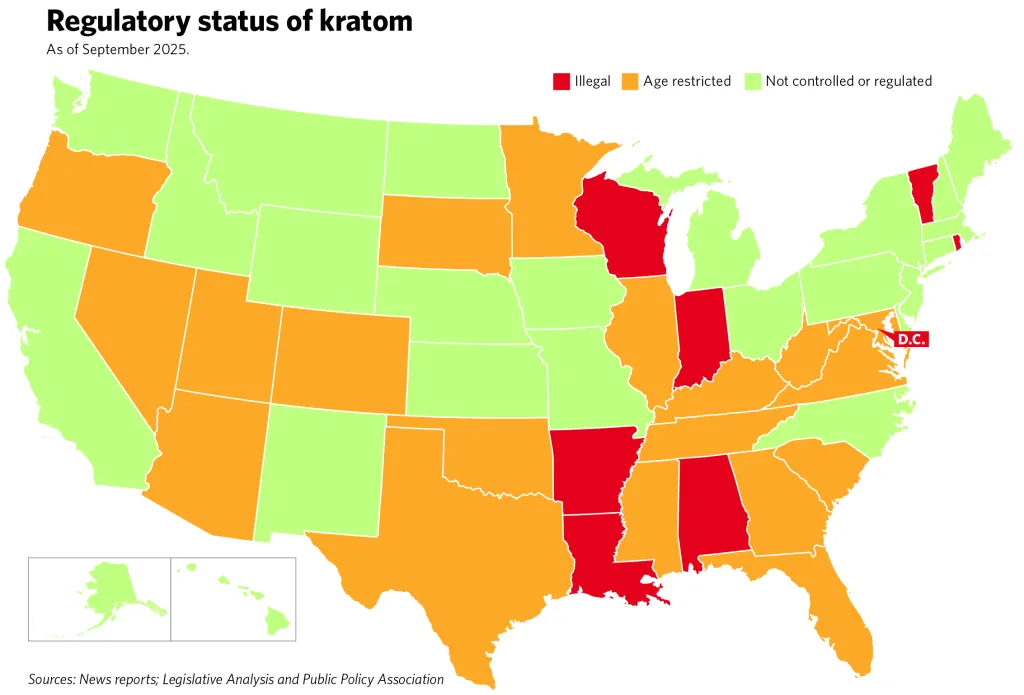
Currently, kratom and its derivatives are lightly regulated under a patchwork of state laws. Here in S.C., for instance, kratom sales were restricted to adults 21 and older under a law that went into effect on July 11 of this year.
Meanwhile in response to a July FDA request, the U.S. Drug Enforcement Administration is studying whether to classify 7-OH — or 7-hydroxymitragynine as it’s formally known — as a Schedule I drug like LSD or heroin, which would essentially make products containing the compound illegal under federal law.
In a Sept. 4 interview, Mac Haddow of the American Kratom Association said his group backs the FDA’s request.
“We fully support those efforts,” he said. “This is a chemically manipulated product that poses an imminent threat to consumers and shouldn’t be on the market.”
What the science says
According to 7-OH marketers, who claim that millions find pain relief with responsible use of their products, the FDA isn’t following the science.
“If 7-OH were truly the threat being claimed, the data would show it,” said Jeff Smith of the Holistic Alternative Recovery Trust, an industry trade group. “It doesn’t.”
But University of Florida researcher Christopher McCurdy, who’s studied kratom for more than 20 years, told Statehouse Report that highly concentrated 7-OH-infused products amount to unregulated opioids.
“It’s essentially legal morphine,” he said.
To understand why, he said it helps to know a little more about kratom and its primary active agent, mitragynine.
Mitragynine is what chemists call an alkaloid, meaning that it’s an organic compound that has pronounced effects on the human body. At low doses, it acts as a mild stimulant. At higher doses, it becomes a sedative with pain-relieving qualities.
It achieves those effects by binding lightly with opioid and serotonin receptors in the brain.
By contrast, 7-OH, an alkaloid that’s only found in trace amounts in dried kratom, binds tightly with opioid receptors, making it 10 to 20 times more potent than morphine, according to some animal studies.
“That molecule is one we’ve been very concerned about for many years now,” McCurdy said. “It’s very different from the whole leaf kratom.”
That’s not to say that the kind of highly concentrated kratom products now on shelves aren’t also a matter of concern, he noted.
“I don’t really see that there’s too much problem with the leaf material as it exists in nature,” he said. “But as with anything, when you look at increasing exposure to a substance, you increase the effects and you increase the risk of harm.”
Meanwhile in South Carolina
S.C. Sen. Russell Ott, D-Calhoun, said he wasn’t familiar with kratom before receiving a call from a constituent a few years ago. But what he heard from that concerned family member kicked off a research project that eventually led him to introduce a bill to ban kratom products from S.C. store shelves.
“That didn’t go anywhere,” he told Statehouse Report Sept. 3. “It just wasn’t on anyone’s radar.”
So this year, he said, he came back with a narrower bill that took aim at what he saw as the industry’s worst practices — unrestricted sales to minors, poor labeling regarding ingredients and potency, and synthesized products like 7-OH.
Ott’s legislation passed in May — after a furious lobbying effort by the 7-OH industry that got the provision banning products removed.
“It was still a heavy lift,” he said. “But I put as many guardrails around it as I possibly could.”
Beyond that, he said he’s pleased that the federal government is considering tougher action, because “for me, it’s not over.”
“I’ve made it clear to everybody that if I get an opportunity to vote on a bill to ban kratom, I probably will,” he said.
That day can’t come fast enough for one Lowcountry professional who spoke to Statehouse Report anonymously to protect his family’s privacy.
He said he first learned of kratom from his adult children, who said it helped them emotionally.
After trying kratom, he said he got pain relief similar to what he’s experienced in the past from prescription opioids. And, he added, “it feels pretty damn good.”
But after looking into kratom carefully and later experiencing some after-effects, he said he decided to set it aside before addiction could become a problem — an issue he believes is affecting his children, who spend hundreds of dollars monthly on kratom-infused drinks.
“I know it won’t be easy, but I wish they’d get off it,” he said. “Eventually, they’re going to have to go through the withdrawal and just do it.”
The DEA has not announced a timeline for the 7-OH scheduling process. In the meantime, several states, including Ohio and Utah, are currently considering bans.
- Have a comment? Send to: feedback@statehousereport.com
S.C. Senate to take up bill to completely ban abortion
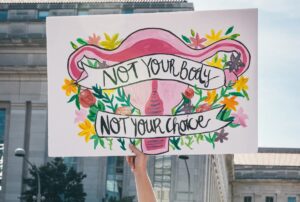
By Jack O’Toole, Capitol bureau | Victims of rape and incest would no longer have access to abortion in South Carolina if a bill set for discussion in the S.C. Senate Medical Affairs Committee on Oct. 1 ever becomes law.
Sponsored by Anderson County GOP Sen. Richard Cash with cosponsors Sens. Rex Rice, R-Pickens, and Billy Garrett, R-Greenwood, the so-called Unborn Child Protection Act would replace the state’s six-week abortion ban with a complete ban at conception. It also would make abortion a felony on a par with homicide. Current exceptions for rape, incest and fetal anomalies would be eliminated.
Under the proposal, people could face 30 years in prison for a variety of violations, from performing an abortion or helping a person to get an abortion to taking a minor out of state to get the procedure. The bill, however, has unclear language related to the fate of South Carolina adult women who received abortions – in or out of the state. But in a Sept. 4 press release, the American Civil Liberties Union of South Carolina argued that it would, in fact, “allow imprisonment up to 30 years for a person having an abortion.”
Also in the proposed bill: the apparent criminalization of popular forms of birth control including the pill, hormone injections and implants, many IUDs and emergency “Plan B” contraceptives.
Cash introduced the bill in February, telling his colleagues that “human life begins at conception and deserves legal protection.” He later added, “I don’t see how any of us could be satisfied with having a law on the books that does not actually protect human life beginning with the biological beginnings of human life, which is fertilization.”
But ACLU-SC Advocacy Director Courtney Thomas called the legislation “unconstitutional and deadly.”.
“This bill would criminalize medical care, invade our privacy, and place unconstitutional restrictions on speech, travel and association. Any lawmaker who cares about the health and safety of South Carolinians should be fighting tooth and nail to stop this bill.”
South Carolina’s current six-week ban is already one of the most restrictive abortion bans in the industrialized world, according to the Center for Reproductive Rights.
In other recent news
McMaster wants to exclude candy, sodas from grocery store assistance program. South Carolinians would no longer be able to buy candy, sodas and other sugary drinks with government grocery benefits under a proposal released Thursday.
Bright to enter state Senate race to reclaim seat. Former GOP state Sen. Lee Bright says he’s running to reclaim his Upstate seat in a special election following the resignation announcement last month of Sen. Roger Nutt following an Alzheimer’s diagnosis.
S.C. voter data to Trump administration blocked by judge. A state judge has temporarily blocked the state Election Commission from providing some voter data to the federal government before a hearing next week.
Parental leave law covers stillbirths, attorney general’s office says. Top lawyers for the state say a law that allows educators to get six weeks of paid time off after a child is born should also be offered when a child is stillborn.
S.C. chief justice issues interim policy on AI. With bad artificial intelligence on the rise in courtrooms, the state’s top judge has issued some interim guidance saying AI may not be used without approval.
May to represent himself. Former S.C. Rep. R.J. May, (R-Lexington), who was arrested in June on 10 charges of sending images and videos of children being sexual abuse, reportedly will represent himself during a trial set to begin next month. He has pleaded not guilty. The founding member of the ultra-conservative Freedom Caucus resigned his House seat last month.
State laws still make tattoo shops hard to own. The fight to legalize tattoos in South Carolina was won just in the current century. The state made it legal in 2004. Cities and counties could still have other laws restricting them.
S.C. hands-free driving law now in effect. South Carolina drivers are no longer allowed to hold or support any electronic device while behind the wheel as of Monday.
Less than half of S.C.’s 3rd to 8th graders can do math on grade level. More than half of South Carolina’s third- through eighth-grade students still can’t do math on grade level, even as reading scores reached all-time highs, according to state standardized testing data released Tuesday.
At packed, joyous Gaillard, Jackson talks Southern roots, role of dissent. In a hot pink suit and sparkling smile, U.S. Supreme Court Justice Ketanji Brown Jackson warmly presided over a sold-out, cheering Tuesday crowd of 1,800 fans at Charleston Gaillard Center.
- Have a comment? Send to: feedback@statehousereport.com
Tinfoil hat

Award-winning cartoonist Robert Ariail has a special knack for poking a little fun in just the right way. This week, he pokes fun at kooky conspiracy theories and U.S. Rep. Nancy Mace, the Charleston-area Republican running for governor.
- Love this week’s cartoon or hate it? Did he go too far, or not far enough? Send your thoughts to feedback@statehousereport.com.
British poem celebrates hope in tough times
By Andy Brack | Another death. Another funeral.
 Another friend taken too early by that cruel, smarmy bastard – cancer. Another person whose throaty laugh and shining glint in the eyes are gone.
As we age, we encounter death more often, too often. Making sense of it, dealing with it and grieving about it is part of grappling with the lives we lead.
For many, funerals help the living. For others like me, they’re often dour occasions to be endured and gotten through as tributes to lives. They’re a way to pay respect to families, friends and the living.
This week’s funeral, however, offered something different in the familiar format – a poem that touched something deep inside. Poems, psalms, hymns and other biblical readings are standard parts of services. But this time, the short stanzas of one poem got through. Maybe these words will help you as you increasingly encounter deaths as you age. They’re from a short work called “Remember Me,” or sometimes listed in funeral programs as “She is Gone” (or “He is Gone” if the pronouns are changed):
You can shed tears that she is gone; or you can smile because she has.
You can close your eyes and pray that she will come back; or you can open your eyes and see all that she has left.
Your heart can be empty because you can’t see her; or you can be full of the love that you shared.
You can turn your back on tomorrow and live yesterday; or you can be happy for tomorrow because of yesterday.
You can remember her and only that she is gone; or you can cherish her memory and let it live on.
You can cry and close your mind, be empty and turn your back; or you can do what she would want: smile, open your eyes, love and go on.

Simple. Sad. Powerful. Calming. Majestic.
What is uplifting is how these few words can lead one to a conclusion that celebrating a friend’s life may be a stronger alternative than succumbing to grief and pain. The words offer a path toward moving forward.
The poem’s backstory adds more interest. It apparently became a popular piece for funerals after Queen Elizabeth II picked it to be part of her mother’s funeral in 2002. At that point, the author was attributed as anonymous.
But it wasn’t too long before news stories circulated that the author had been a bakery worker and aspiring artist in Carlisle, England, who wrote a slightly different version in 1981 as a poem of unrequited love, not as a funereal tribute. According to Wikipedia and other sources, he sent the piece to publishers for a while, but didn’t have any luck. He later stopped writing, but through the years, the poem, with some slightly changed words from the original, started circulating on the internet, later gaining renewed life at the Queen Mother’s service.
This week’s commentary obviously isn’t on the normal back-and-forth about politics and policy. But in these days in which there’s so much friction and division, reread the words and think about the times in which we live. Things might seem frustrating, sad or bad now – just as when someone dies – but there’s likely a way to look at things with fresh vigor, have hope and press onward to preserve our democracy.
Because without hope – especially in South Carolina – we can’t breathe and live fully.
Dum spiro spero. And goodbye, old friend.
Andy Brack is editor and publisher of the Charleston City Paper and Statehouse Report. Have a comment? Send to: feedback@statehousereport.com.
Old street scene

Here’s an old image – heck, you can see Model-T Ford type vehicles – of a South Carolina street. Where was it? Send your best guess to: feedback@statehousereport.com.
Last week’s mystery photo, “Big shoes,” probably should have been called “big sandals.” Nevertheless, longtime sleuths recognized the feet as being part of the Confederate Defenders of Charleston statue overlooking Charleston harbor at White Point Gardens.

Kudos to readers who correctly identified it: David Lantrip of Houston, Texas; Allan Peel of San Antonio, Texas; George Graf of Palmyra, Va.; Lester Dempsey of Charleston; Steve Willis of Lancaster; Jay Altman of Columbia; David Lupo of Mount Pleasant; Brenda Clark of Irmo; and Larry Musetti/
- SHARE: If you have a Mystery Photo to share, please send it to us – and make sure you tell us what it is!
Send us your thoughts
Please send us your thoughts about politics and policy in South Carolina, but make sure to leave phone numbers and hometowns to help us verify them for publication. We publish non-defamatory comments, but unless you provide your contact information – name and hometown, plus a phone number used only by us for verification – we can’t publish your views.
- Have a comment? Send your letters or comments to: feedback@statehousereport.com. Make sure to provide your contact details (name, hometown and phone number for verification. Letters are limited to 150 words.
Statehouse Report, founded in 2001 as a weekly legislative forecast that informs readers about what is going to happen in South Carolina politics and policy, is provided by email to you at no charge every Friday.
- Editor and publisher: Andy Brack, 843.670.3996
- Statehouse bureau chief: Jack O’Toole
Donate today
We’re proud to offer Statehouse Report for free. For more than a dozen years, we’ve been the go-to place for insightful independent policy and political news and views in the Palmetto State. And we love it as much as you do.
But now, we can use your help. If you’ve been thinking of contributing to Statehouse Report over the years, now would be a great time to contribute as we deal with the crisis. In advance, thank you.
More
- Mailing address: Send inquiries by mail to: P.O. Box 21942, Charleston, SC 29413
- Subscriptions are free: Click to subscribe.
- We hope you’ll keep receiving the great news and information from Statehouse Report, but if you need to unsubscribe, go to the bottom of the weekly email issue and follow the instructions.
- Read our sister publication: Charleston City Paper (every Friday in print; Every day online)
- © 2025, Statehouse Report, a publication of City Paper Publishing, LLC. All rights reserved.