- BIG STORY: Future S.C. Guard law enforcement deployments possible
- MORE NEWS: Trump administration can have your voter info, S.C. court rules
- LOWCOUNTRY, Ariail: Quack
- BRACK: Is the country at a tipping point?
- MYSTERY PHOTO: Painted sign
- FEEDBACK: Commentaries are informative
Future S.C. Guard law enforcement deployments possible
By Jack O’Toole, Capitol bureau | Two hundred South Carolina National Guard (SCNG) troops deployed to Washington, D.C., in early August as part of President Donald Trump’s crime crackdown should be back in the Palmetto State by Sept. 30.
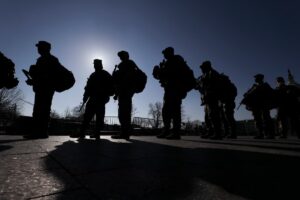
“South Carolina National Guard will conduct a relief-in-place with the Georgia National Guard and expects its soldiers to return home to South Carolina before the end of the month,” Maj. Karla N. Evans told Statehouse Report in a Sept. 11 email.
S.C. Gov. Henry McMaster authorized the Washington deployment on Aug. 16, after President Donald Trump declared a “crime emergency” in the nation’s capital.
News that S.C.’s Guardsmen would soon be heading home came on the heels of Georgia Gov. Brian Kemp’s Sept. 5 announcement that his state would contribute 300 troops to relieve some soldiers currently serving in D.C. — a mission that Trump has called “a historic action to rescue our nation’s capital from crime, bloodshed, bedlam and squalor.”
Critics of Trump’s move to use soldiers for domestic law enforcement note that crime in Washington has fallen steadily since a pandemic-related spike in 2020, though the numbers still remain well above the national average.
Since deploying to Washington, Palmetto State Guardsmen have “engaged in a broad range of public safety support activities—including Metro station presence, high-traffic patrols, traffic operations and school safety initiatives,” Evans said.
Asked for specific examples of Guardsmen’s activities during the operation, SCNG pointed Statehouse Report to the Guard’s news channels, where a video news release detailed work in helping to apprehend a robbery suspect on Aug. 31.
“I stayed with that individual as he was moving down the street to keep track of his location,” Staff Sgt. Hardy Bogue said in the video. “The police came up quickly … and they apprehended the individual.”
In contrast, one Palmetto State resident who recently visited Union Station in Washington told Statehouse Report he saw troops from other states that seemed to be stuck with little to do.
“I was able to talk to several of them as they were largely just standing
around, and many of them seemed quite bored,” he said. “Most of the time, they were just gathered in groups talking.”
“Right decision”
In a Sept. 9 visit with Palmetto State Guardsmen, Republican U.S. Sen. Tim Scott of S.C. said Trump made “the right decision” in sending the troops.
“The men and women of the National Guard represent the principles that keep our country strong, and I am grateful for their commitment to public safety and the security of vulnerable citizens,” Scott said.
But with Trump threatening to send troops to more cities amid news reports of declining morale among those deployed, some are beginning to wonder what’s next for South Carolina’s guardsmen — and whether they’re being asked to take on a mission that critics say could turn dangerous in a New York, Atlanta or Chicago minute.
As president, Trump has significant authority over the federal district in Washington, including direct command of its National Guard, which legal experts say has provided a legal basis for the D.C. deployments.
But when he indicated that Chicago would be next, saying in a Sept. 6 social media post that the city “is about to find out why it’s called the Department of War,” Illinois officials were quick to push back.
“The president is using fear to deflect and drive a wedge among us,” U.S. Sen. Dick Durbin said. “Unfortunately, he seems to be succeeding to some extent, but the people of Chicago won’t take kindly to a bully and a wannabe dictator.”
At press time, it was unclear where Trump’s troops-to-Chicago plan stood, with the president telling reporters on Sept. 10 that he’s now considering sending troops to “another city” where the governor and mayor “would love us to be there.”
Asked Wednesday whether McMaster would consider sending troops to Chicago or any other city if asked, the governor’s office directed Statehouse Report to his public comments of Aug 26.
“There’s no doubt in some of these big cities [people] aren’t safe,” McMaster told reporters. “So as long as we are requested to do it and as long as the law allows it … we will help.”
Unfair to troops?
But Charleston Democratic Sen. Ed Sutton, a decorated combat pilot who flew one of the last American military planes out of Kabul, Afghanistan, told Statehouse Report he believes the whole exercise unfairly politicizes the nation’s armed forces.
“It’s incredibly unfortunate that our National Guard is being used as political props,” Sutton said in a Sept. 10 interview. “Nobody signed up for this service.”
In particular, he said, he’s concerned about the safety of both troops and citizens in a place like Chicago, given that the National Guard is trained to fight, not to police cities.
“A military action and a law enforcement action are two totally different animals,” he said. “So we’re just applying the wrong tools to the problem there.”
Finally, Sutton argued, the deployment divides the country in ways that S.C. GOP leaders might see more clearly if the positions were reversed.
“Imagine if Illinois sent troops to a South Carolina city against our governor’s wishes under a Democratic president,” Sutton said. “Those folks in Columbia would be screaming their heads off about Big Brother and federal overreach, and rightly, if the shoe was on the other foot.”
- Have a comment? Send to: feedback@statehousereport.com
Trump administration can have your voter info, S.C. court rules
By Jack O’Toole, Capitol bureau | The S.C. Election Commission can turn over its voter database to the U.S. Department of Justice after the state Supreme Court on Thursday tossed a lower court injunction blocking the transfer.

In the unanimous ruling, the justices found that S.C. Circuit Judge Diane Goodstein’s Sept. 2 order “falls far short” of establishing that the South Carolina resident who sued to stop the transfer would suffer “immediate and irreparable damage” if election officials surrendered the information.
The Justice Department has said it needs state voter data to ensure federal election security, though critics note that widespread voter fraud has never been found in a modern American election.
With the injunction lifted and the case ready to proceed on the merits, Gov. Henry McMaster’s office lauded the Supreme Court’s ruling in a comment to the S.C. Daily Gazette.
“Gov. McMaster has said all along that this case was improper,” spokesman Brandon Charochak said in a statement. “Today’s ruling is a major victory for South Carolina.”
In court filings, attorneys for the governor argued that turning over the data wouldn’t cause harm to South Carolinians since the federal government already has virtually all the information in one place or another, though privacy advocates noted that some of that data is shielded from Justice Department access.
Despite the high court’s decision, attorney and Democratic state Sen. Brad Hutto, who’s leading the charge to stop the data release, told The Post and Courier that he doesn’t expect any immediate action.
“I think it’s highly unlikely the Election Commission is going to hit the ‘send’ button today, before we’ve had a hearing,” he said.
According to reports, the state Supreme Court will decide whether to take the case or allow it to continue moving through the lower courts on Sept. 21.
In other recent headlines
S.C.-1: Bowtie-wearing doctor McCown enters S.C. congressional race. Sam McCown, a former doctor, announced he will run for Congress as a Republican in South Carolina’s 1st District in a launch video released Sept. 9, to succeed U.S. Rep. Nancy Mace.
S.C. bill seeks to restore prayers in schools. South Carolina lawmakers are working on passing a bipartisan bill that aligns with Trump’s call to reintroduce prayer and religious expression in public schools.
S.C. debates benefits of legal sports betting. There have been several pieces of legislation that have been discussed in the statehouse to legalize sports gambling in the state. One sport and entertainment management professor at the University of South Carolina said when a state legalizes sports gambling, it generally sees a boost in tax revenue.
S.C. leaders have ideas to fix state roads, but will they work? South Carolina officials are scrambling to find the resources required to maintain the state’s massive roads system, but the financial, political and practical challenges are daunting.
Lawmakers consider expanding health care access to speed treatment. State lawmakers are hearing comments on bills to provide care more quickly through nurse practitioners and physician assistants without direct doctor supervision.
How a former state lawmaker is defending himself in court. This story looks into how former state Rep. R.J. May is defending himself on federal charges related to child sex abuse videos in federal court, where a hearing was held Wednesday.
S.C. federal judge delays ‘forever chemicals’ case amid flood of new claims. U.S. District Judge Richard Gergel temporarily halted proceedings in a case brought by Americans who say they’ve been harmed by “forever chemicals” after 37,446 new claims were filed in the last week of August alone.
- S.C. law banning eight concepts on race can stay in place, judge says
- U.S. Supreme Court rules S.C. transgender boy can use boys’ bathroom
- Have a comment? Send to: feedback@statehousereport.com
Quack

Award-winning cartoonist Robert Ariail has a special knack for poking a little fun in just the right way. This week, he pokes fun at Florida’s surgeon general for being a quack about vaccines.
- Love this week’s cartoon or hate it? Did he go too far, or not far enough? Send your thoughts to feedback@statehousereport.com.
Is the country at a tipping point?
By Andy Brack | The idiom you’ve probably heard more times than you can count is that hindsight is 20-20, meaning that it may be pretty easy now to see how and why something happened in the past.

For example, looking back, historians and politicians came up with all sorts of high-falutin’ explanations of why the Soviet Union crumbled and the Berlin Wall fell. But in the middle of everything leading up to it, did anyone really see that it would happen so quickly? Not really. Even people like the late Czech writer and leader Vaclav Havel, who opposed the Russian bear for years, were taken by surprise, writes cultural observer Malcolm Gladwell in last year’s “Revenge of the Tipping Point.”
Another of several hindsight examples in the book is gay marriage – which seemed like a mountain for activists to climb for decades until it quickly happened starting around 2012. Gladwell points not to politics, but to a television show as moving the nation toward a tipping point to accepting gay marriage. And he quotes former conservative U.S. Sen. Rick Santorum, R-Penn., looking back:
“I was in politics for 16 years and I realized something particularly on the moral and cultural issues,” he said in a speech. “It’s that politics does not shape those issues. Popular culture shapes those issues, particularly the issue of [gay] marriage … When it came to the issue of marriage, and changing the definition of marriage, there was no change. None, zero, for 30 years. And then a television show came on the air called Will & Grace.”
Gladwell’s book also seems to seek to quantify tipping points in several discussions about a concept called the “magic third.”
One example is in elementary education. In general, he writes, studies show when Black kids are a minority in majority White classrooms, they fall behind more and more every year. In first grade, they often are 6% behind their White peers, but just five grades later, they can be 20% behind on testing measures.
But if the percentage of Black kids in classrooms rises to 25% or 30%, scoring differences dramatically shift – and the Black students don’t fall behind. There’s a “magic” number of having other people who look like them that seems to create a dynamic so that the Black students succeed, not fail.
Another example cited – women on corporate boards. When corporate boards grudgingly started to diversify away from all White men, women didn’t really feel their voices were heard or that they made a difference when they were one of nine on a board. Add another and little changed. But if a third woman joined the board, the dynamic shifted. The majority started paying attention and the corporate culture changed, Gladwell writes, because of the magic third.
Such a concept – people being exposed to popular mass culture like a television show about a gay man living with a woman friend or the percentage of kids being in a classroom – is a kind of social engineering.
But it raises interesting questions in today’s partisan, polarized political environment where no one can seem to get along and everything seems volatile: Is it possible that we now are in the middle of a national tipping point on how we want to govern in the future – but we don’t see it because we’re in the middle of it? Is it possible in two or four years that it will all be obvious in hindsight what was going to happen – even though the politicians and pundits seem incapable today of prognosticating our future?
I believe we are inside of a tipping point – and that it could go either way. There are a lot of people who are sick and tired of authoritarian crap infecting the democracy that our forefathers died for. But there are also a lot of people enraged by how they’ve been left out – and they seem to be willing to embrace simplistic, authoritarian solutions and rhetoric at the expense of their liberty.
The next election will tell us a lot – but it’s going to take more than any magic third for things to change.
Andy Brack is editor and publisher of the Charleston City Paper and Statehouse Report. Have a comment? Send to: feedback@statehousereport.com.
Painted sign

Here’s a sign painted somewhere in South Carolina on a wall. It might be a little hard to figure out, but where is it? Send your best guess to: feedback@statehousereport.com.
Last week’s mystery photo, “Old street scene,” was a postcard image of downtown Sumter more than 100 years ago.

Kudos to readers who correctly identified it: Allan Peel of San Antonio, Texas; Ty Atkins of Sumter; George Graf of Palmyra, Va.; Jay Altman of Columbia; Don Clark and Bill Segars, both of Hartsville; Vickie P. Snyder of Aiken; and David Lupo of Mount Pleasant.
- SHARE: If you have a Mystery Photo to share, please send it to us – and make sure you tell us what it is!
Commentaries are informative
To the editor:
I appreciate your articles so much! They are always so informative. The one on governments was very, very meaningful to me. I worked for the federal government for 24 years and my colleagues and I worked very hard — and know we made a difference in people’s lives. I am angry when I hear negative comments about local, state and federal governments and civil servants.
Your article was “right on.” Of course, I am greatly concerned about our current administration. I agree that many of these people “simply hate government” and are destroying our country., I am fearful for our country. And thank you for reminding us of the importance of critical thinking skills.
– Jean Barton, Port Royal, S.C.
Poem was uplifting
To the editor:
Thank you for the poem. It is uplifting and needed. I appreciate the thoughtful perspective of your comments. My sympathy for your loss.
– Margaret Adams, Greenwood, S.C.
Send us your thoughts
Please send us your thoughts about politics and policy in South Carolina, but make sure to leave phone numbers and hometowns to help us verify them for publication. We publish non-defamatory comments, but unless you provide your contact information – name and hometown, plus a phone number used only by us for verification – we can’t publish your views.
- Have a comment? Send your letters or comments to: feedback@statehousereport.com. Make sure to provide your contact details (name, hometown and phone number for verification. Letters are limited to 150 words.
Statehouse Report, founded in 2001 as a weekly legislative forecast that informs readers about what is going to happen in South Carolina politics and policy, is provided by email to you at no charge every Friday.
- Editor and publisher: Andy Brack, 843.670.3996
- Statehouse bureau chief: Jack O’Toole
Donate today
We’re proud to offer Statehouse Report for free. For more than a dozen years, we’ve been the go-to place for insightful independent policy and political news and views in the Palmetto State. And we love it as much as you do.
But now, we can use your help. If you’ve been thinking of contributing to Statehouse Report over the years, now would be a great time to contribute as we deal with the crisis. In advance, thank you.
More
- Mailing address: Send inquiries by mail to: P.O. Box 21942, Charleston, SC 29413
- Subscriptions are free: Click to subscribe.
- We hope you’ll keep receiving the great news and information from Statehouse Report, but if you need to unsubscribe, go to the bottom of the weekly email issue and follow the instructions.
- Read our sister publication: Charleston City Paper (every Friday in print; Every day online)
- © 2025, Statehouse Report, a publication of City Paper Publishing, LLC. All rights reserved.