- BIG STORY: State election officials deal with data demands, staff tumult
- MORE NEWS: McMaster urges twin storm prep amid FEMA turmoil
- LOWCOUNTRY, Ariail: Boots on the ground
- BRACK: Rough road ahead for Trump presidency
- MY TURN, : Partnerships help small towns make roads safer
- MYSTERY PHOTO: Big lizard in my backyard
- FEEDBACK: On being conservative
State election officials deal with data demands, staff tumult
By Jack O’Toole, Capitol bureau | Gov. Henry McMaster on Thursday won court approval to intervene in a lawsuit seeking to block South Carolina’s Election Commission from giving the personal data of 3.3 million voters to the U.S. Department of Justice (DOJ) — a transfer he has said he supports.
At a Sept. 24 hearing, attorneys for Anne Crook, the Calhoun County voter who filed the lawsuit, argued McMaster was politicizing the case and exceeding his statutory authority over the independent commission by attempting to intervene.

But in a Sept. 26 statement, McMaster attorney Grayson Lambert rejected the allegation.
“This is not about politicizing anything,” Lambert told Statehouse Report. “This is about defending state law and helping ensure that state law is properly interpreted. The governor is not trying to inject himself into the commission’s negotiations with the DOJ.”
In a one-page written decision later that day, S.C. Circuit Judge Daniel Coble ruled McMaster’s inclusion was timely, relevant and unlikely to delay or prejudice the case — meeting the state’s “liberal” standard for third-party intervention.
Busy time
Coble’s ruling capped a remarkable eight days in which the Election Commission ousted its top two officials for what it said were unrelated personnel issues, and continued to negotiate with Trump administration officials over access to the sensitive voter records, which include Social Security and driver’s license numbers.
It also came on the same day the U.S. Department of Justice announced it was suing six more states, including California and Illinois, for failing to comply with similar data requests, bringing the total to eight — and underscoring the pressure on S.C. election officials.
“Clean voter rolls are the foundation of free and fair elections,” U.S. Attorney General Pamela Bondi said in a release. “Every state has a responsibility to ensure that voter registration records are accurate, accessible and secure — states that don’t fulfill that obligation will see this Department of Justice in court.”
But privacy-rights advocates argue the federal data demands — which they say now affect more than 30 states — are an improper infringement on states’ constitutional role in managing elections and will put citizens’ private data at risk of political misuse and criminal hacking.
‘Unprecedented’ overreach?
Despite vague references to “clean voter rolls” and “protecting American citizens from voting fraud and abuse” in press releases, federal officials have not clearly stated their reasons for requesting the voter data, critics say.
The Justice Department’s Aug. 6 letter to S.C. election officials, for instance, briefly mentions enforcement of the National Voter Registration Act and the Help America Vote Act, but does not explain how surrendering the state’s voter file to federal officials would further that goal.
Voting and privacy advocates told Statehouse Report this week that they can’t see any clear connection between enforcing laws that require states to maintain accurate voter rolls over time and securing a one-time snapshot of voter data.
“Voter rolls are living documents that change every day,” said Eileen O’Connor, senior counsel with New York University’s Brennan Center for Justice in a Sept. 25 interview. “So the stated purpose just doesn’t make any sense.”
Instead, she argued, the Trump administration’s goal appears to involve the creation of “a national voter registration database” by “sweeping up” the private data of every voter in the country.
“This appears to be part of an unlawful attempted federal takeover of elections,” O’Connor said.
What’s more, that kind of national database would provide a convenient, one-stop-shop for criminal hackers, she noted.
“There are security issues when you amass data, because then a breach of that data is all the more damaging,” O’Connor said.
Federal officials have not directly addressed concerns about potential political abuse or hacking. But in a statement to Stateline earlier this month, an unnamed Justice Department official confirmed that the department is sharing the data with Homeland Security officials to allow “the American people to choose their leaders, not illegal aliens.”
Upheaval at the S.C. Election Commission
Meanwhile, as the federal data demands were playing out in courtrooms in S.C. and across the country, the state Election Commission was dealing with a more immediate issue — the sudden dismissal of its top two officials.
First, the commission voted 3-2 on Sept. 17 to fire Executive Director Howard Knapp, citing “a desire for new leadership.” Then, five days later, the commission fired its deputy executive director, Paige Salonich, after it said she was caught on a security camera placing an unauthorized listening device in the workplace. State Law Enforcement Division officers are reportedly investigating the incident.
Chief of Staff Jenny Wooten is now serving as interim executive director, according to Commission Chairman Dennis Shedd. A retired federal judge, he added in a Sept. 25 statement to Statehouse Report, “The commission’s leadership and staff remain dedicated to ensuring South Carolina’s elections are accurate, secure and accessible.”
That’s a message local officials, such as Charleston County Board of Voter Registration and Elections Executive Director Isaac Cramer, were quick to endorse.
“The beauty of South Carolina elections is that they’re managed at the local level,” Cramer said in a Sept. 25 interview. “Voters in our county and across the state can rest assured because we stand at the ready and prepare for elections all year round.”
Proceedings in Crook’s lawsuit to block the state data transfer are scheduled to resume Sept. 26. As the case now moves forward with McMaster’s involvement, state election officials told Statehouse Report on Sept. 25 that they are waiting for a proposed memorandum of understanding from the Justice Department on the terms of a data-sharing agreement.
- Have a comment? Send to: feedback@statehousereport.com
McMaster urges twin storm prep amid FEMA turmoil
By Jack O’Toole, Capitol bureau | Gov. Henry McMaster is urging citizens to monitor weather reports closely for the next several days as two tropical systems appear headed for the Carolinas.
“Storm track, speed and landfall forecast may change quickly,” McMaster warned in a Sept. 25 social media post. “South Carolinians along the coast should immediately start paying attention to weather information and alerts from official sources.”

The first storm, officially dubbed Hurricane Humberto early Friday morning, is currently expected to stay out in the Atlantic, creating swells and rip currents along the S.C. coast.
But it’s the second system, currently known as Invest 94L, that has S.C. emergency managers watching the tropics. According to current modeling, the system has a 90% chance of developing into a major storm, with likely tracks showing it headed for the coastlines of the Carolinas.
A year ago, Hurricane Helene ripped through the state, leaving 50 S.C. residents dead or missing and causing about $1.5 billion in damage.
Also worrisome are major changes at the Federal Emergency Management Agency (FEMA), where President Donald Trump has fired hundreds of employees and reportedly suspended at least 30 more who signed a recent letter warning of significant dysfunction at the agency.
State officials recommend that residents visit the S.C. Emergency Management Division website at SCEMD.gov for hurricane preparedness news and information.
In other recent news
S.C. House Freedom Caucus, House GOP Caucus to battle next month. Elections in late October and early November will test the popularity of the House Freedom Caucus in the legislature.
Graham said he would support third term for Trump. Even though a constitutional amendment limits presidential terms, U.S. Sen. Lindsay Graham said he’d like to see President Trump have a third term.
2026: A look at Stumbo’s race for S.C. attorney general. Upstate Solicitor David Stumbo is running in an increasingly crowded field to be the GOP nominee for attorney general.
S.C.’s unemployment rate ‘ticking up’ amid market uncertainty, economists say. State economists said Sept. 25 that there are more unemployed South Carolinians than there are job openings for the first time since 2020 and the state’s unemployment rate is beginning to “tick up.”
Public safety officials release citation numbers from “Operation Keep Us Safe.” The five-day initiative to enhance the safety of law enforcement, first responders, highway workers and tow truck drivers working on roadways in South Carolina resulted in 1,815 total citations, according to the S.C. Department of Public Safety.
Ex-South Carolina sheriff pleads guilty to stealing from police fund. Former Spartanburg County Sheriff Chuck Wright agreed to plead guilty Thursday to stealing money from the force’s benevolence fund and taking pain pills that were supposed to be destroyed as part of a narcotics take-back program.
Last unconnected South Carolinians could come online with broadband. The Palmetto State needs just $41.4 million of its federal share to finish, according to the Broadband Office. But there’s more than $500 million that may be left in grant funding — and what becomes of that is unknown, according to this story.
Smithsonian review could affect S.C.’s Gullah heritage. A White House-ordered review of the Smithsonian museums could result in the removal of a Lowcountry sweetgrass basket maker’s work.
- Have a comment? Send to: feedback@statehousereport.com
Boots on the ground
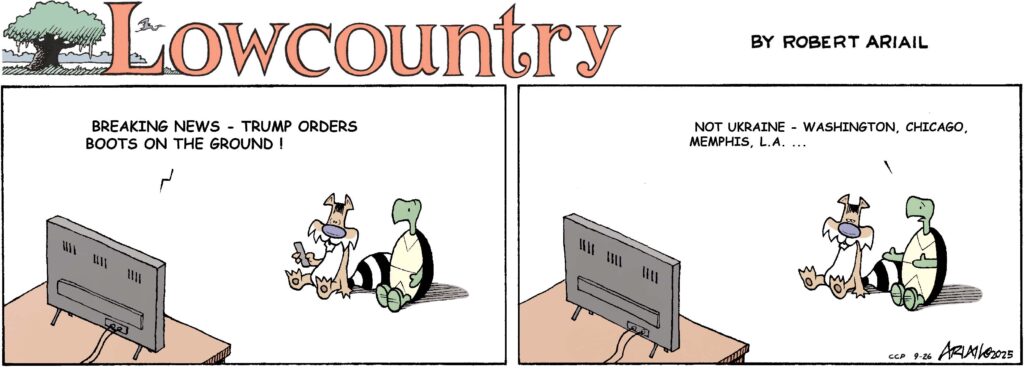
Award-winning cartoonist Robert Ariail has a special knack for poking a little fun in just the right way. This week, he points to the overzealous use of National Guard troops.
- Love this week’s cartoon or hate it? Did he go too far, or not far enough? Send your thoughts to feedback@statehousereport.com.
Rough road ahead for Trump presidency
By Andy Brack | America seems to be souring on President Donald Trump.
This may not be surprising after the national reaction to pressuring ABC/Disney to suspend late night comedian Jimmy Kimmel and an embarrassing Sept. 23 speech at the United Nations that can, at best, be described as unhinged.
Trump’s approval ratings are upside down with 54% of American voters disapproving, compared to 42% approving of what he’s doing in the White House.
“Trump’s approval ratings across a wide range of polls are both lower than his historical highs and low compared with many other post-World War II presidents,” according to writer Louis Jacobson at the award-winning Politifact journalism website. “An aggregation of polls by former FiveThirtyEight.com editor and Substack author G. Elliott Morris shows the most recent polling average for Trump is 41.9% approval and 54.2% disapproval.
“At the start of his second term, Trump was above water in the polling average, with an approval rating of 50.7% and a disapproval rating of 38.7%.”
That’s a 15-point swing in eight months. In an interview, analyst Jacobson observed that controversies generally don’t change the minds of Trump’s supporters or critics.
“(But) his low ratings on the economy would seem especially important. A lot of people voted for Trump in 2024 because of inflation and the economy, especially a lot of voters who didn’t have strong feelings otherwise.

“If he can’t improve his approval ratings, especially on the economy, it will complicate his party’s task heading into the midterms – because midterms are generally a referendum on the incumbent president and their party. The out-of-power party has usually gained in midterm elections, especially in the House.”
Scott Huffmon, the chief pollster for South Carolina’s Winthrop Poll, noted that Trump’s current support is under water across an array of issues.
“This [dropping] trend across multiple polls is driven by independents but they are always the hardest to turn out, especially in off-years,” Huffmon said. “He is still sky-high among Republicans nationally. Consistently mid-80s.”
But it’s unclear how long that will last, particularly if approval/disapproval numbers grow further apart as fresh polling that takes into account the impact of Kimmel, his flamboyant return and Trump’s U.N. speech that offended leaders across the world.
“Coalitions of discontent – the model that explained presidential approval until Bill Clinton – could definitely be building,” Huffmon said. “If the GOP can keep things focused on identity politics and ensure that marginal-news consumers feel a constant series of vaguely defined threats, they may win enough ‘lean Republican’ districts and keep a few tossups, then Dems might not be able to flip the House.”
But if Democrats are able to focus on economics, such as how Trump hasn’t decreased the price of groceries and how his tariffs are really bad for farmers and small businesses, they may be able to flip the House – just as they did in 2018 when they picked up 41 seats at the midpoint of Trump’s first term.
A new September poll shows 47% of Americans say they’ll vote for Democrats and 42% for Republicans on a generic ballot. The same poll of 1,500 people showed 60% believed the country was on the wrong track, compared to 28% of people who said it was on the right track. That’s a 3% increase in pessimism over the previous month.
Perhaps the best indicator of what the country’s really thinking will come on Oct. 18 when people see the number of Americans who protest Trump at hundreds of the scheduled No Kings rallies across the country. Millions are expected.
While there are a lot of political parallels between what’s happening now in Trump’s second term compared to the same time in his first term, protests and increasingly virulent anti-Trump sentiment across the country could make the 2026 midterm elections more volatile than ever before.
- Andy Brack is editor and publisher of Statehouse Report and the Charleston City Paper. Have a comment? Send to: feedback@charlestoncitypaper.com.
Partnerships help small towns make roads safer
By Lake City Mayor Yamekia Robinson, special to Statehouse Report | The headlines constantly tell of partisan quarrelling and major challenges to our nation. We small-town mayors must stay focused on the basics, however, and here in Lake City, nothing ranks higher than street safety. It’s crucial that our residents can walk, bike and drive to get where they need to go.
South Carolina has a poor traffic-safety record. We are tied for the second-highest rate of traffic fatalities per 100,000 vehicle miles, trailing only Mississippi.

Lake City is a hub between larger municipalities on U.S. Highway 378, which many South Carolinians use to reach Myrtle Beach. Or they might see our town as a brief delay on U.S. Highway 52 between Florence and Charleston. One reason we need safer streets is that many drivers fail to slow down as they pass through.
The good news is that traffic fatalities nationwide are dropping, albeit very slightly. South Carolina has seen some modest improvement recently, too, but it’s not nearly enough. For instance, our number of traffic deaths per 100,000 miles driven is slightly higher (1.7) than it was in 2014 (1.6). We also had more traffic fatalities per capita.
We must do better.
Fortunately, Lake City recently received a $176,000 Safe Streets for All grant from the U.S. Department of Transportation, part of the big infrastructure package passed by Congress a few years ago. We stayed active and focused to retain our award—and to see it through.
Granted, $176,000 may not sound like a huge sum. But it will enable us to plan ways to make our roads and sidewalks safer. We hope to later leverage this grant for a larger sum to implement the plans.
It is not easy for towns to navigate federal grant opportunities, or to write successful applications in this competitive process. Small places like ours lack the large, experienced staff that bigger cities have. So, we turned to the Local Infrastructure Hub as a partner. Led by Bloomberg Philanthropies, the national initiative offers pro-bono grant-writing bootcamps and trainings with infrastructure leaders for municipalities seeking federal funds. Supporters include the Ballmer Group, Emerson Collective, Ford Foundation, Waverly Street Foundation and The Kresge Foundation. Its partners include the U.S. Conference of Mayors, National League of Cities, and Results for America.
The consortium has provided expert assistance and hands-on technical support to more than 2,400 municipalities nationwide, including more than 1,200 municipalities like ours: those with 150,000 or fewer residents.
Our city benefitted tremendously. Local Infrastructure Hub experts provided detailed, point-by-point advice for crafting proposals that compellingly describe our town’s needs and ambitions. They were especially helpful in focusing on the data collection, resource, and analysis necessary to win.
Aside from expertise on developing strong grant applications, the program’s participants—peers from other localities—share ideas and experiences with officials from other cities. Such strategy-sharing helps civic leaders stay sharp, innovative and up to date–and to learn from one another.
I recently organized a Florence County Mayors’ Forum for the nine cities of our county (Florence is the largest municipality at a population of over 39,000, and Lake City is second at 6,000), where mayors can discuss common issues, recent developments and share insights on possible improvements.
These are good examples of towns reaching out in creative ways to access the assistance they can find, be it grants, training seminars, or smart advice. Lake City certainly needs a hand. Our population is slowly declining. It peaked at 7,153 in 1990, and now is below 6,000. Our median household income ($35,000) is less than half the national average; our poverty rate is more than double.
But rather than focus on our problems, we work energetically to grow and keep our residents safe. Collaborations to address these needs help us thrive.
It’s easy to criticize government, and sometimes it’s deserved. But let’s speak up and give credit when governments get things right and make Americans’ lives better. It’s all the better when philanthropic groups—such as the Local Infrastructure Hub—pitch in.
Here in Lake City, we are working diligently to bring investment home, but we need partners. We’re grateful to find them, and we will keep working to make our residents’ lives—and futures—as fruitful and fulfilling as possible.
- Yamekia Robinson was elected mayor of Lake city in 2022.
Big lizard in my backyard

This week’s mystery photo headline is a song by the Dead Milkmen – but also the subject of a photo somewhere in South Carolina. Might be hard to find, but try. Where is it? Send your best guess – plus hometown and name – to: feedback@statehousereport.com.
Last week’s mystery, “squat brick building,” shows an old YMCA building near the College of Charleston on its new site for a new dorm. Problem now is that there may be hundreds of people buried in unmarked graves below the asphalt.

Congrats to the few who correctly identified the building at 106 Coming St. in Charleston: George Graf of Palmyra, Va.; Jay Altman of Columbia; Allan Peel of San Antonio, Texas; David Lupo of Mount Pleasant; and Steve Willis of Lancaster.
- SHARE: If you have a Mystery Photo to share, please send it to us – and make sure you tell us what it is!
On being conservative
To the editor:
As a conservative, I have to admit your column today was the first one with which I have totally agreed. Please try a little harder to be a little more conservative.
– Lea McCallum, Greenwood, S.C.
Editor’s Note: Lea, I can’t be what I’m not, but quite frankly, I’m a moderate. I believe in paying bills, not borrowing more money and treating people with respect, not bullying. Those are pretty conservative things.
Send us your thoughts
Please send us your thoughts about politics and policy in South Carolina, but make sure to leave phone numbers and hometowns to help us verify them for publication. We publish non-defamatory comments, but unless you provide your contact information – name and hometown, plus a phone number used only by us for verification – we can’t publish your views.
- Have a comment? Send your letters or comments to: feedback@statehousereport.com. Make sure to provide your contact details (name, hometown and phone number for verification. Letters are limited to 150 words.
Statehouse Report, founded in 2001 as a weekly legislative forecast that informs readers about what is going to happen in South Carolina politics and policy, is provided by email to you at no charge every Friday.
- Editor and publisher: Andy Brack, 843.670.3996
- Statehouse bureau chief: Jack O’Toole
Donate today
We’re proud to offer Statehouse Report for free. For more than a dozen years, we’ve been the go-to place for insightful independent policy and political news and views in the Palmetto State. And we love it as much as you do.
But now, we can use your help. If you’ve been thinking of contributing to Statehouse Report over the years, now would be a great time to contribute as we deal with the crisis. In advance, thank you.
More
- Mailing address: Send inquiries by mail to: P.O. Box 21942, Charleston, SC 29413
- Subscriptions are free: Click to subscribe.
- We hope you’ll keep receiving the great news and information from Statehouse Report, but if you need to unsubscribe, go to the bottom of the weekly email issue and follow the instructions.
- Read our sister publication: Charleston City Paper (every Friday in print; Every day online)
- © 2025, Statehouse Report, a publication of City Paper Publishing, LLC. All rights reserved.